

Divorce
 2 Feb 2026
A Straightforward Guide to the Five Steps of No-Fault Divorce
Divorce is rarely an easy decision. For many people, it comes at a time of emotional strain and uncertainty, particularly when the legal process feels unfamiliar or overwhelming. It is also common for couples to want clarity and efficiency, so that matters can be resolved without adding unnecessary stress or conflict to an already difficult situation.
Read more 27 Jan 2026
Which Mistakes Should Be Avoided in Family Court Proceedings?
Disputes involving children and finances are often closely connected. Decisions about where a child lives, how they spend time with each parent, and how finances are resolved are frequently shaped by the same underlying issues: trust, communication and the ability to prioritise long-term stability.
Read more 8 Jan 2026
Are International Divorce Rates Higher in January?
From the perspective of someone who leads a UK Family Law department acting predominantly in matters with a cross-border element, the short answer is yes, but the more interesting question is why.
Read more 8 Dec 2025
How Do Christmas Contact Arrangements Operate Following Parental Separation?
Speak to a member of our specialist international team of UK family lawyers today on 0330 107 0107. Christmas is often one of the most emotionally sensitive times of the year for separated parents. With family traditions, travel plans and school holidays to consider, it is no surprise that many parents seek legal guidance from IMD […]
Read more 8 Dec 2025
Managing Child Contact Over the Christmas Holidays
Speak to a member of our specialist international team of UK family lawyers today on 0330 107 0107. Christmas is often one of the most emotionally sensitive times of the year for separated parents. With family traditions, travel plans and school holidays to consider, it is no surprise that many parents seek legal guidance from IMD […]
Read more 3 Nov 2025
What Are the Grounds for Divorce in England and Wales?
What are the grounds for divorce in England and Wales? Since April 2022, there has been one clear answer. The Divorce, Dissolution and Separation Act 2020 introduced a single legal ground: that the marriage has broken down irretrievably.
Read more 27 Oct 2025
A Simpler Way to Separate (or Plan Ahead): The Single Solicitor Service in Family Law
When a couple decides to separate or divorce, the first assumption is often that each person needs to “lawyer up”, hiring opposing solicitors to negotiate everything from finances to child arrangements. But this traditional, adversarial model doesn’t suit every family.
Read more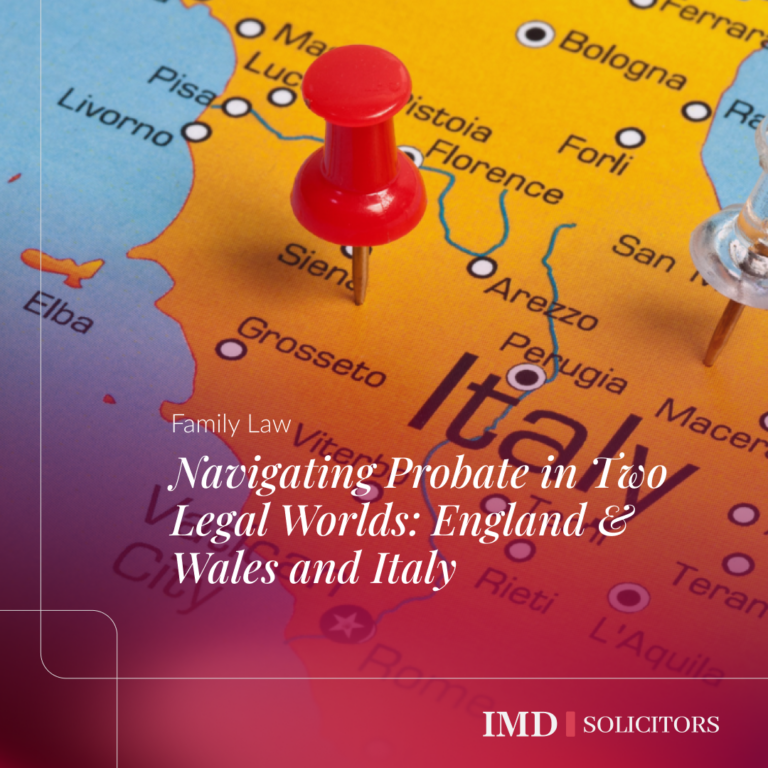 21 Oct 2025
Navigating Probate in Two Legal Worlds: England & Wales and Italy
When someone passes away, the legal process of handling their estate can be complex—especially when it crosses borders. As a dual-qualified Solicitor and Avvocato, I often support clients who are navigating estates involving both England & Wales and Italy. Despite some surface similarities, the probate processes in these two jurisdictions are fundamentally different, rooted in contrasting legal traditions, expectations, and systems of inheritance.
Read more 7 Oct 2025
Court Order for Child Contact: What Happens If the Mother Manipulates Arrangements?
At the heart of this case was the welfare of a two-year-old boy. It also raised the rights of his father, our client, to develop and maintain a meaningful relationship with his child. A court order was in place. However, the father was unable to exercise his contact rights, because the mother persistently manipulated the arrangements.
Read more